
Measure Sports Feed Latency with Four Timestamps
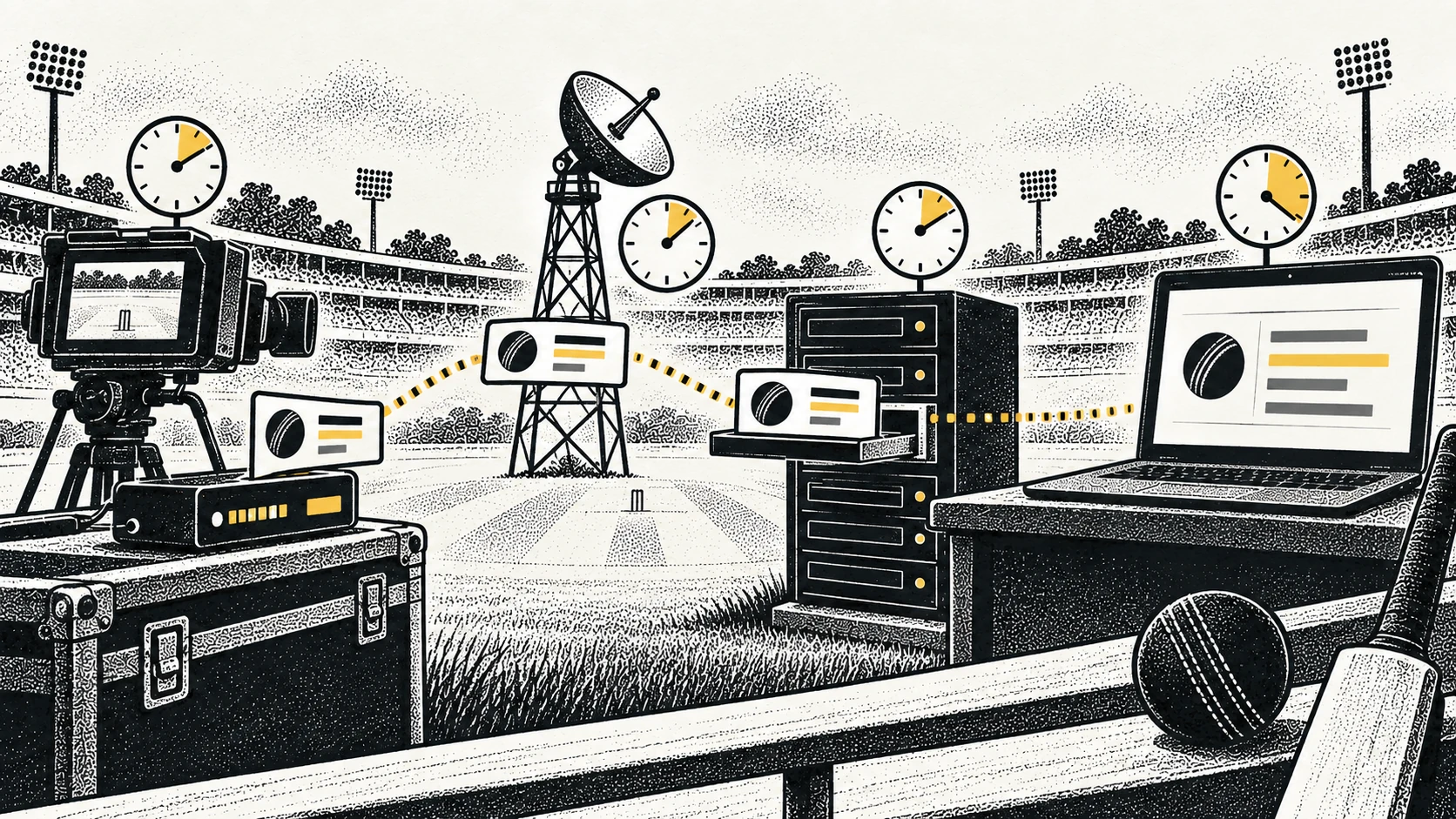
Sports feed latency is not one number unless the measurement boundary is defined. A supplier response time, a collector's processing delay and a user's screen delay answer different questions.
Instrument four points where possible: source publication, collector receipt, accepted internal state and browser render. Label any point you cannot observe rather than substituting a convenient guess.
Define the timing record
For each sampled update, preserve a stable record identifier and the four timestamps. Ensure that the measurements refer to the same update, not merely the same match.
Source and receiver clocks may differ. Document synchronization, precision and known uncertainty. A negative interval can indicate clock disagreement rather than exceptionally fast delivery.
Work through one update
In a hypothetical measurement, an update is published at 10:00:00.000, received at 10:00:00.150, accepted internally at 10:00:00.230 and rendered at 10:00:00.480.
The observed intervals are 150 milliseconds for delivery, 80 for processing and 250 for distribution plus rendering. Publication-to-render is 480 milliseconds, assuming comparable clocks. It is not ground-to-screen latency because the sporting event's occurrence time was not measured.
Sample representative conditions
Include different event loads, device classes and network conditions. Record collector region, application version and test dates. Avoid extrapolating a short desktop test into a global performance claim.
Measure failed and missing observations too. Reporting only updates that arrived successfully can make a disrupted feed appear fast.
Look for the controllable bottleneck
If internal processing accounts for most delay, changing suppliers may not solve the problem. If browser rendering dominates, inspect update batching and page complexity. If source publication is already old, faster local code cannot recover the lost time.
Use the breakdown to assign work to the right owner. A single aggregate number often encourages the wrong team to optimize the wrong stage.
Report what cannot be measured
If a source publication timestamp is absent, report receipt-to-render delay instead of inventing source-to-render latency. If clocks are not synchronized, explain the possible offset before interpreting small differences between providers.
Consider a fictional observation where the receiver's clock is 300 milliseconds ahead of the source clock. A calculated 400-millisecond publication-to-receipt interval could include that offset. Without a trustworthy clock relationship, the number cannot support a precise network-delay claim.
Clock uncertainty does not make all measurement useless. Durations measured within a single process can still answer narrower questions, provided the chosen clock is appropriate for elapsed time and the start and end events are defined.
Keep the sample record reproducible
For each observation, retain an event or update reference, the available timestamps, the clock sources and the application version. Mark missing fields explicitly. Avoid filling them with the receipt time merely to create a complete row.
Report the sampling window and the number of successful, failed and unmeasured observations. A performance chart built only from successful updates may hide the most important user experience: no update arrived at all.
When comparing two configurations, keep event scope and test conditions as consistent as practical. If one run covers a quiet fixture and another covers peak traffic, describe the difference. The goal is a decision supported by the measurement's actual precision, not a contest between numbers whose uncertainty is concealed.
Report a method, not a slogan
Publish sample size, median and tail measurements, missing-data rate and the measurement boundary. Keep synthetic demonstrations clearly labelled. Do not describe an illustrative calculation as a benchmark.
For 7 Unicorn Gaming's Odds API, confirm which source timestamps are available and use the live data page only as an initial inspection point. A credible latency statement is one that another engineer can reproduce under the stated conditions.