
How to Audit Sports API Coverage Before You Buy
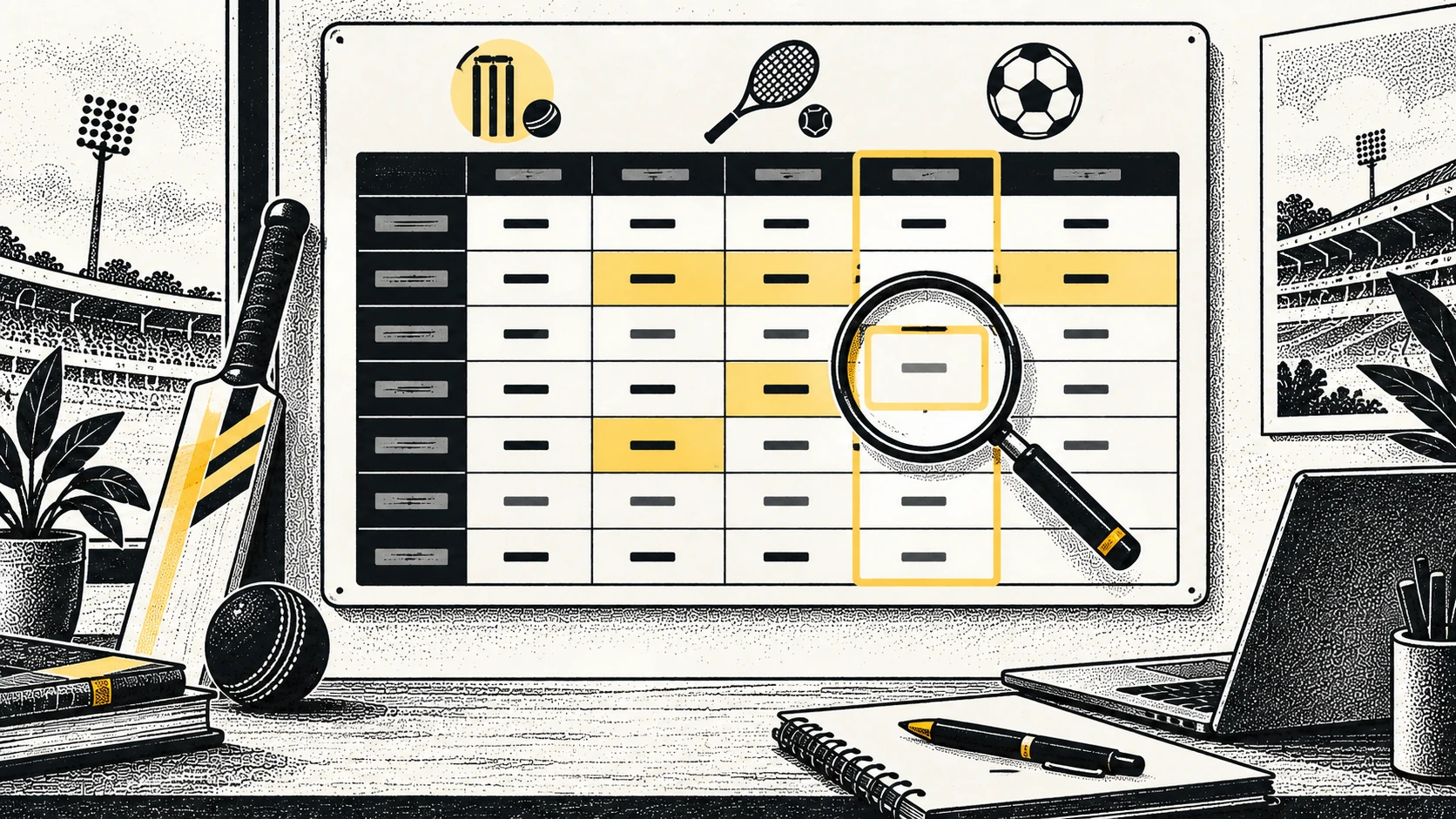
Sports API coverage is a relationship between a competition, a data type and a point in the event lifecycle. “Cricket supported” does not tell you whether tomorrow's fixtures appear, whether confirmed lineups arrive, or whether an interrupted match receives a revised result.
A useful audit starts with the matches your product actually needs. It ends with a list of confirmed capabilities and known gaps that your interface can handle honestly.
Build a representative sample
Choose upcoming and completed fixtures across your required competitions. Include different match formats, quieter scheduling periods and at least one example with a correction or interruption if a replay is available. Do not judge the whole service from a single high-profile match.
Document the sampling window. A trial covering one week proves what happened during that week; it does not establish year-round coverage. Ask separately about future seasons and competitions outside the trial.
Check fields across the lifecycle
- Before the event: Evidence to request – Schedule, participants, identifiers; A common hidden gap – Late-added fixtures
- During the event: Evidence to request – Score, state, update timestamps; A common hidden gap – Missing lower-tier detail
- After the event: Evidence to request – Final record and revision history; A common hidden gap – Corrections never propagated
Mark each cell as observed, supplier-confirmed or unverified. Those labels prevent a salesperson's answer from being mistaken for a measured result.
For 7 Unicorn Gaming, compare the scope described on its Score API page with the particular competitions and fields your product requires. Product descriptions should guide the test, not replace it.
Weight coverage by your own priorities
Suppose a hypothetical product assigns 60 points to its core competition, 25 to a secondary competition and 15 to an occasional competition. The trial finds complete required records for 100%, 80% and 40% of the sampled fixtures respectively.
The weighted score is 60 × 1.00 + 25 × 0.80 + 15 × 0.40 = 86 out of 100. That result is more meaningful than saying “three competitions supported,” but it is still a sample score, not a forecast.
Do not allow a high aggregate score to hide a mandatory failure. Missing final results for the core competition may disqualify the feed even when the weighted total looks strong.
Distinguish missing from delayed
A field that arrives late and a field that never arrives require different product responses. Record the first-seen time, last-observed time and final availability. When timestamps are unavailable, label your measurement as receiver-side observation rather than source latency.
Also check whether absence is explicit. An empty list, a null field and a “not covered” status may have different meanings. Your application needs to distinguish them before displaying an error.
Finish with a coverage agreement
Produce a short annex naming required competitions, fields, phases and exclusions. Add who will report future changes. Repeat the audit when adding a sport or season rather than assuming that a successful initial trial covers every expansion.
The live data demonstration can help you inspect examples. A production decision needs a broader, documented sample and a clear account of what remains unverified.