
Sports Data API Requirements: Write the Brief Before the Demo
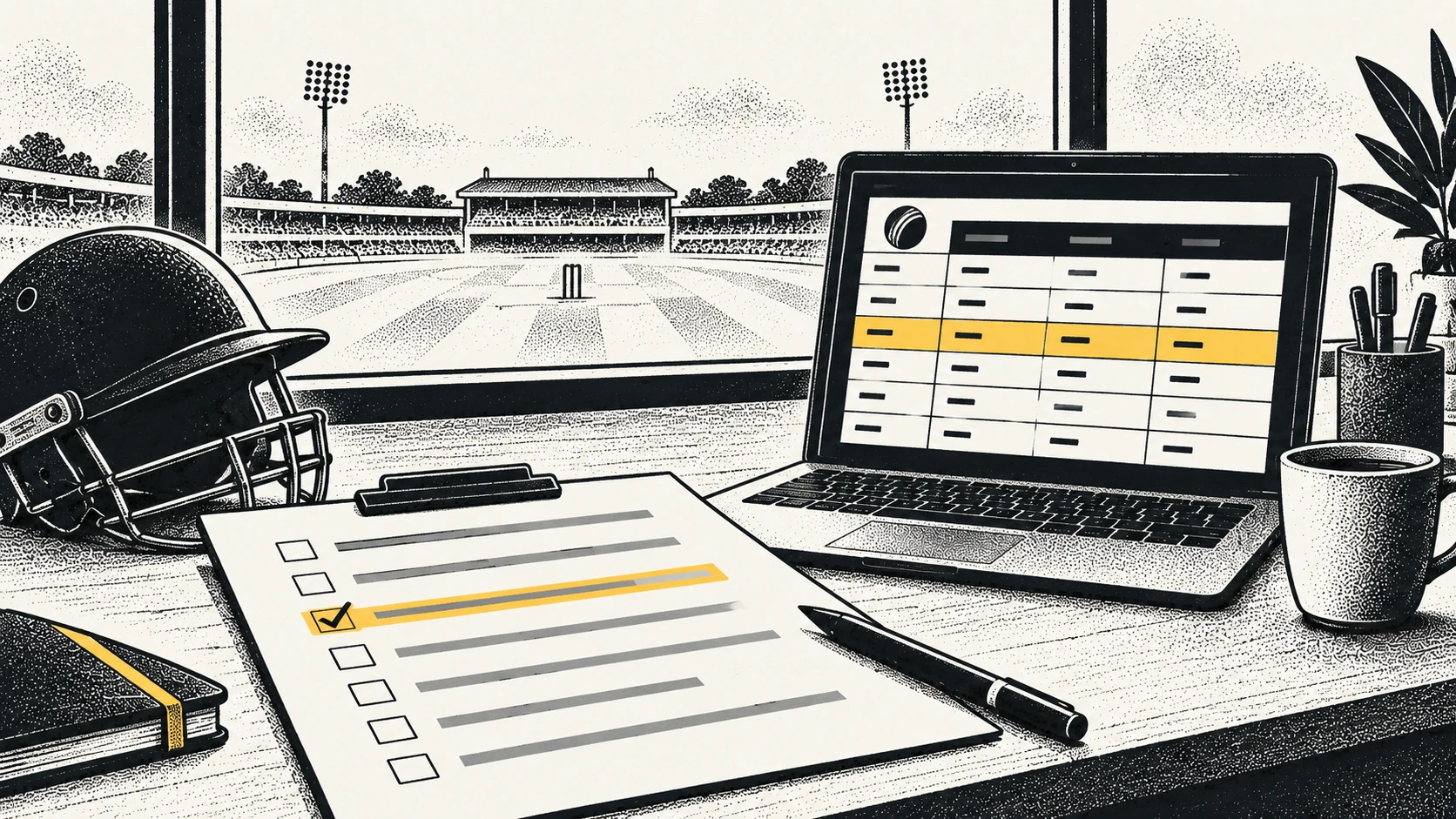
A sports data API brief should describe what your product must do, what evidence will prove it works, and who owns the decision. A list of sports is only the beginning. Two suppliers can both offer cricket while delivering very different fixture depth, update timing and correction handling.
The most useful first document is a one-page requirements table. Write it before watching a polished demo: otherwise the supplier's strongest features can quietly become your priorities.
Start with one user journey
Consider a hypothetical match centre. A visitor opens tomorrow's fixtures, selects a match, follows the live score, then returns later to see the result. That journey needs schedule data, stable event identity, live updates and a durable final record. It does not automatically require video, every player statistic, or every historical season.
Describe the journey in plain language. Then break it into data obligations. If the interface shows a playing XI, someone must provide its confirmation state. If the result can change, the application must recognize a revised record.
Use five columns
- Named competitions: Must or optional – Must; Evidence – Fixtures from an agreed sample; Failure response – Hide unsupported coverage; Owner – Product
- Live score freshness: Must or optional – Must; Evidence – Timestamped trial observations; Failure response – Show delayed status; Owner – Engineering
- Corrected results: Must or optional – Must; Evidence – Replay of a correction; Failure response – Flag revision; Owner – Data lead
- Video: Must or optional – Optional; Evidence – Device playback test; Failure response – Keep scorecard available; Owner – Frontend
This is an example structure, not a claim about any provider's contractual obligations. Its value is the final two columns. They expose decisions that otherwise surface during an incident.
Replace adjectives with evidence
“Fast,” “complete” and “easy” are not acceptance criteria. Replace “fast updates” with a defined observation point and threshold suitable for the product. Replace “all major cricket” with a named competition list. Replace “easy integration” with a developer completing a fixture-to-result workflow using the supplied documentation.
Keep commercial and technical requirements connected. A feed may pass the data test but exclude your intended redistribution or deployment arrangement. Record that dependency before treating the trial as a success.
Make exclusions visible
List what the first release will not do. For the example match centre, that might be historical video, automated commentary translation and cross-provider player comparisons. These are scope choices, not missing features to conceal.
An exclusion should have an owner and a review trigger. “Revisit player comparisons when the second season launches” is more useful than “phase two,” which can mean almost anything.
Translate the brief into a trial request
A requirement becomes easier to test when it names a sample and an observable outcome. For the match-centre example, request one upcoming fixture, one live fixture and one completed fixture, plus an authorized replay of a correction. That is a starting set, not enough evidence to establish complete coverage.
Give each requirement a reference such as R1 or R2 and use that reference in the trial notes. If a sample cannot be supplied, mark the requirement unverified and assign the next action. Do not allow a missing sample to disappear into a meeting summary.
For freshness, record the exact comparison being requested. “Update visible within the agreed interval after source publication” needs a trustworthy publication timestamp. If the feed exposes only receipt time, the team must choose a different measurable condition or acknowledge the evidence gap.
Decide who can accept a limitation
Engineering can explain that a field is unavailable, but product ownership may need to decide whether the feature can still launch. Commercial teams may need to resolve a permitted-use question. Assign those decisions before the trial ends.
Consider a hypothetical missing lineup-confirmation field. The buyer could remove the confirmed-lineup claim, show a clearly labelled provisional list, or postpone that feature. Those choices have different user consequences. Recording the decision is more useful than leaving a developer to invent a default label.
The brief is complete when each must-have has an evidence path and each conditional requirement has a decision owner. It should remain short enough to update when the product scope changes.
Send the same brief to every supplier
Ask each supplier to mark requirements as supported, conditional, unavailable or awaiting confirmation. Request a short explanation for conditional answers. This makes differences visible without an arbitrary star rating.
7 Unicorn Gaming's service catalogue is a starting point for mapping product categories. Use the contact page to confirm the exact scope against your brief. The decision should rest on the completed requirements table and trial evidence, rather than the number of features in a presentation.